THE CYNEPHILE

"The cinema is cruel like a miracle." -Frank O'Hara

A Pot-pourri of Links

art + video
It’s Armory Week, and the number of openings, events and parties in the next few days makes my head spin. Aside from the usual mainstays, the new kid on the block this year is the Independent. Born out the ashes of X-initiative, it offers an alternative to the inescapable shopping mall ambiance of the art fair — there’s even a panel on gluttony! And a film program too. Check it out here.

Scope also has a video program, with work by Martha Colburn, George Kuchar and fashion-y films. Sashay!

design
Check out the next generation of Polish film poster design.

fashion
Look who’s copying a page from the Vezzoli playbook: Agyness Deyn deigns to appear in a McDermott and McGough film.

film reviews
Andrew Grant (nom de blog: filmbrain) reviews The Ghost Writer, and thinks it’s pretty good.
You should see it, especially since all proceeds from the film go to the Roman Polanski legal defense fund. (Kidding!)

mystery flavor
My favorite posthuman Andrei Codrescu is anti-Avatar, and pro-zombie. Deliciously brainy as always.

zombie_vampire_hybrid
My friend Ziyan and I as zombie-vampire hybrids. Kristen Stewart, eat your heart out.

new york
Movie program ephemera from the 8th street Playhouse, which I remember going to as a little girl. Thanks to reader Jack for the tip.

photography
Andy Warhol: Unexposed Exposures just opened at Steven Kashar.
If the Factory had had a facebook page, these would be the pictures that they would post to their wall. Lots o’ pics online too.

watch online
The first and only truly Beat film Pull My Daisy (Frank and Leslie, 1959) is on Google Video.

Hunger [Steve McQueen, 2009]

Steve McQueen’s Hunger comes out on DVD today from Criterion, and I can’t think of an art-house title from the past year that is more deserving of the “Criterion” treatment (including what must surely be a harrowing Blu-ray release). A video artist turned feature filmmaker, McQueen refuses to talk about his work in convenient, journalist-friendly soundbytes, or define what it’s about for the viewer. In an interview, he cites a conversation between Pauline Kael and Jean-Luc Godard as a source of inspiration for Hunger:

“I found this interview that Godard did with Pauline Kael two days after Bobby Sands died, where Godard essentially said, “The reason why Bobby Sands is important is because he’s childish.” I got this image in my head of this child sitting at the table with some food, and the parents saying, ‘You’re not leaving this table until you finish eating it.’ The kid says no, wrongly or rightly. What time a child goes to bed, or the clothes a child wears, those things are dictated to by experience, and it’s a common situation that the only power a kid has is to refrain from eating. It’s a situation all of us know.”

I love how that one word “childish” spurs an image that allows McQueen to take a specific historical moment — the hunger strike of Bobby Sands — and translate it into a common experience. Here’s what Godard said in the actual interview (Pauline Kael is asking him about film being used a a political weapon):

JLG: …I think a good example is La Chinoise…It was made in 1967 before the 1968 events in France, before the Weatherman here, before the Baader-Meinof in Germany, or the Red Brigade in Italy. At the time it was hated by the left, who said, “These people are ridiculous.” And today, after seeing it fifteen years later, we discover that all of those people, even Bobby Sands a few days ago, are childish, and it’s because they are childish that they are important people.

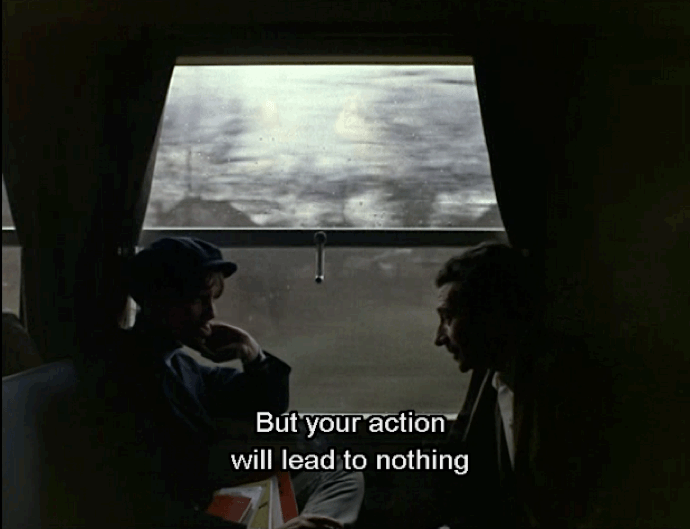
“Childish” here isn’t used as pejorative — Godard seems to be using it as an adjective to encapsulate a strength of conviction, an uncompromising will, and a sense of stubborn refusal. In La Chinoise, there is a pivotal scene in which the university student Veronique has a conversation with Francis Jeanson, a leftist professor. He repeatedly questions her morals, her anger, and what he considers to be her childish revolutionary actions.

la_chinoise

It is evident that the second part of Hunger, in which Bobby Sands confronts a priest who tries to dissuade him from becoming a martyr, is directly inspired by this train conversation. Like La Chinoise, they argue in a very long take, almost in silhouette, forcing the viewer to focus on the dialogue.

Other McQueen news: I recently dropped by his show at Marian Goodman, and despite having missed Yoko Ono by mere moments, I was a bit underwhelmed by Giardini (his film from the Venice Biennale). There is a lovely piece called Static in which McQueen circles the the Statue of Liberty from a helicopter, that transforms the tourist trap back into an object of awe and wonder. It’s a must-see for video art enthusiasts and McQueen completists.

His next project? A biopic about the Nigerian singer Fela Kuti, which will hopefully sidestep the clichés of the genre and will undoubtedly be visually and sonically arresting.

Dennis Lim’s review of Hunger in The New York Times

A nice breakdown of important moments in McQueen’s career from New York Magazine

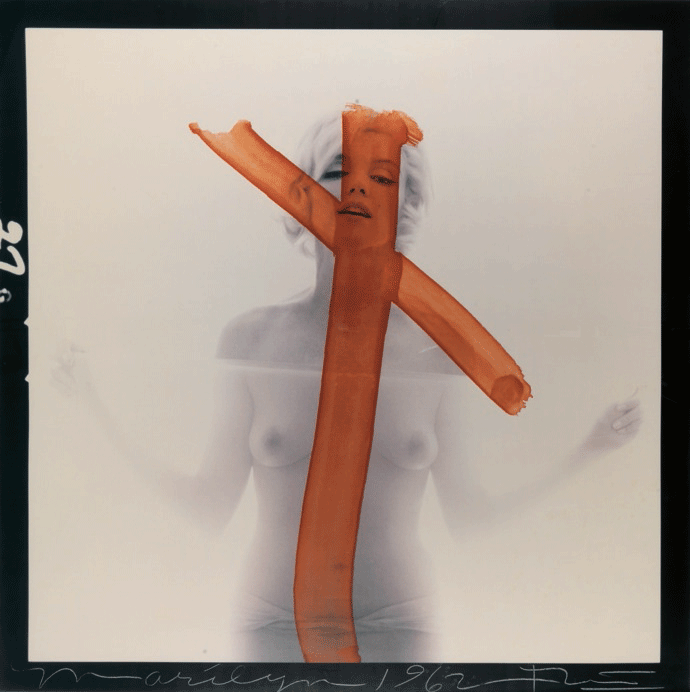
Marilyn Monroe, Crucifix [From Bert Stern's The Last Sitting, 1962]

Marilyn_Monroe_Crucifix_The_Last_Sitting

While I am not a M.M. fetishist, I find this image remarkably unsettling for the way it seems to prophesy her death. During her legendary final photo shoot with Bert Stern, Monroe crossed out the negatives that she didn’t want to published with a magic marker. (She just had a gall-bladder operation, and was ashamed of the scar on her midriff). The red gash on her ghostly body produces an uncanny memento mori — a quality that, according to Roland Barthes, lies at the crux of all photography.

Of course, Marilyn-as-muse is a popular trope in all mediums. Here’s Dalí’s take on the icon, which is obviously a nod (or a jab) in Warhol’s direction. (Duly noted: Monroe’s beauty mark takes precedence over Mao’s mole.)

dali_after_marilyn_monroe
Salvador Dalí, After Marilyn Monroe [1967]


Pasolini, La Rabbia [Rage, 1963]

Restored for the NYFF this year, Pasolini’s La Rabbia interprets Monroe’s death as the killing of all that is innocent and beautiful in the world. My shoddy translation of the last line, spoken over footage of a mushroom cloud: “You’re the first in the world beyond the gates abandoned to death’s fate.”

Omer Fast is the next Steve McQueen

Move over, Ryan Trecartin: Omer Fast is the current video artist taking over New York. His solo turn at the Whitney, combined with a show of recent work at Postmasters, reveal that he is eminently qualified and more than ready to undertake a feature film. Like the British video artist Steve McQueen, whose Hunger wowed the film world, Fast’s work deserves to be seen by a wider audience. His work is largely in the vein of simulated social documentary that exploits the surface effects of the Hollywood film, pushing the format to a well-tempered extreme to strengthen the irony and distance from that which it critiques. Fast doesn’t shirk from the big issues of today: the aftershocks of war and combat, refugees and displaced persons, racial stereotyping, and the tyranny of the modern police state. But the worlds that he creates are marked by reversals, distinctions, nuances and contradictions, and thus his work does not fall prey to the trap of the “issue” film. Technically accomplished, his films evoke more than they explain, in keeping with Fast’s multi-layerd approach to his subject matter. Formally Fast makes use of split screens, green screens, lush film stocks (most of his work is shot on Super-16) and exaggerated sound effects: this is film-as-artifice, all the way. Yet it is so much more than that: each film manages to probe its connections to mainstream media stereotypes, fictions of the self and nation-state, and constructions of a linear time unburdened by memory.

omer_fast_nostalgia_film_still
A still from Nostalgia, 2009. In a hypothetical role-reversed future, an English man is being interviewed for asylum in an unspecified African country.

Fast’s multi-channel pieces, taken together, are approaching feature-film length. I really do think we have the next important auteur on our hands here, and Fast’s quick ascent in the art world closely mirrors that of McQueen. Other potentially useful comparisons: he addresses social concerns similar to the Dardenne brothers. His hybrid approach resembles Isaac Julien’s melding of fiction and documentary. And he is skillful at invoking a self-reflexive critique of media discourse that adds another layer of interpretation to the narrative, like almost all the work of Amos Gitai. Omer Fast is too prodigiously talented to be confined to the white walls of the art world — let’s see his work up on the big screen.

omer_fast_the_big_message
From De Grote Boodschap [The Big Message, 2007]. A Belgium beat-boxer is a unnerving combination of both man and machine.

Holland Cotter’s review of Fast’s two shows, from The New York Times

An interview with Fast and a clip from The Casting, his tour-de force at the 2008 Whitney Biennial

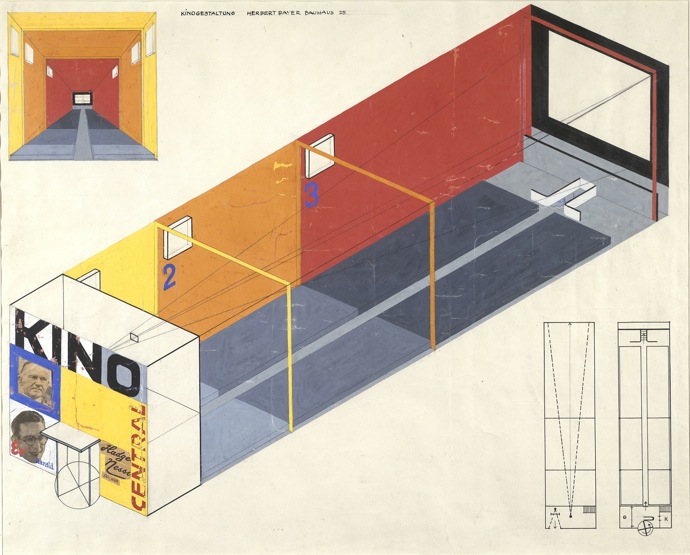
Herbert Bayer, Designs for a Cinema [1924-5]

This weekend is your last chance to catch MOMA’s Bauhaus exhibit, which is enlightening because it reveals that its practitioners (check out those cool cats below) were far from uniform in their approach to art, architecture and life. For me, the big discovery was Herbert Bayer’s design for a cinema [1924-25] and what he calls a “multimedia” trade fair stand to be used for advertising purposes [1924].


In da Bauhaus (actually they were on the roof. Herbert Bayer is fifth from the left.)

Bayer’s design for a cinema is notable for what it lacks: it dispenses with a marquee, which was designed to “embrace” the potential moviegoer on the street and funnel him into the theater. The revolving door is more characteristic of a department store. And I have no idea what those three primary colored zones are meant to indicate. But one can immediately see that this cinematheque is the exact opposite of the movie palaces of the 1920′s, which were derived from theater architecture and were intended to create an opulent and exotic experience.

Even more radical is this multimedia kiosk for a fictional brand of toothpaste, “Regina.” Presumably the booth would lure you in with the sound of her voice.

Bayer is most well known as a type designer. He was a proponent of the almost ubiquitous use of all lowercase letters, and he created the quintessential Bauhaus font Universal, which still looks fresh today. But he also wrote presciently about exhibition design in a way that anticipates future developments in digital media:

“Exhibition design has evolved as a new discipline, as an apex of all media and
powers of communication and of collective efforts and effects. The combined
means of visual communication constitutes a remarkable complexity: language
as visible printing or as sound, pictures as symbols, paintings, and photographs,
sculptural media, materials and surfaces, color, light, movement (of the display
as well as the visitor), films, diagrams, and charts. The total application of all
plastic and psychological means (more than anything else) makes exhibition
design an intensified and new language.”

Here, film is subsumed under a multimedia gesamtkunstwerk that attempts to alter all aspects of the user’s experience. It was already considered just one tool in the virtual reality shed as early as the 1920′s.