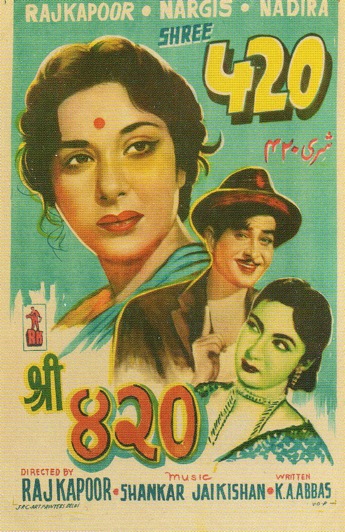
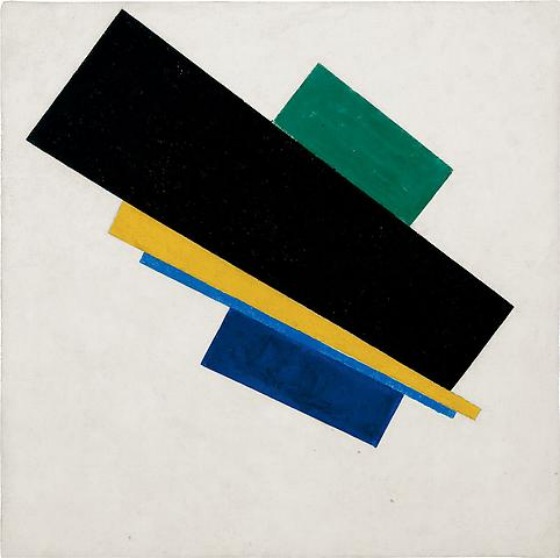
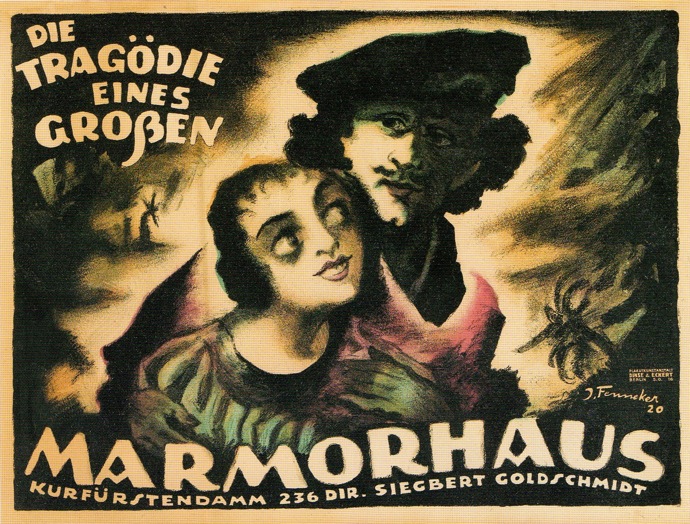
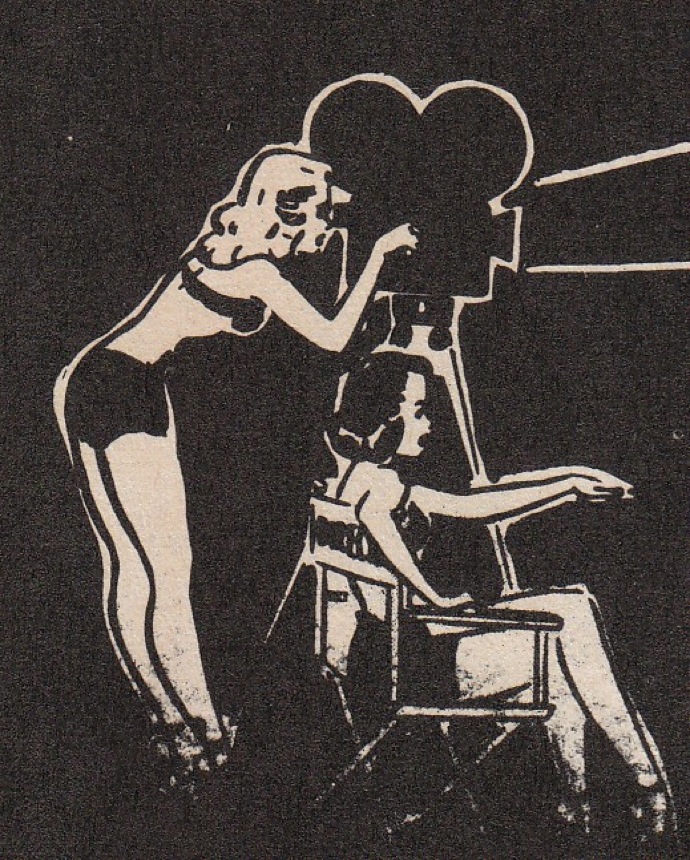
In the United States, movie studios for the most part produced anonymous posters to promote films. In France, however, recognized poster designers were hired to advertise the films they distributed. Rene Peron was one of the leading figures of French film poster design, and over the course of his career, designed more than two thousand posters. King Kong premiered in America on March 3, 1933 and in France on March 16th, 1933. Peron illustrates the iconic scene where Kong is being attacked by airplanes on top of the Empire State Building. Peron’s graphic approach appears relatively straightforward, but look more closely for wonderful touches of Art Deco stylization and lovely use of an airbrush. And oh man, those colors! Pomegranate red, mustard yellow and celadon green have never looked so groovy together. You can just hear M. Kong singing: I’m an apeman, I’m a King Kong man, I’m a voodoo man… (Distributed by La Compagnie Universelle Cinématographique; printed by Presses Universitaires de France, Paris.)
Film Forum is in the midst of a Classic 3D film series that is eye-bulgingly essential for anyone who cares about the past and future of cinema. I dragged a friend to see KIss Me Kate on Sunday and we were transported to such a state of euphoria (spinning diamonds! saucy lyrics! silly outfits! jazz hands! gangsters spouting Shakespeare!) that leaving the theater was like coming out from under ether. (Admittedly this experience was augmented by some ‘50s-era wax soda bottles from Economy Candy that gave us both a suitable sugar high.) According to the trailer, Kiss Me Kate was the greatest event in the history of our times:
Kate is that great, and those who delight in the golden era of 3D will be knocked out by Film Forum’s pristine dual projection. Moreover, cinephiles who are sickened by the success of the behemoth Avatard and the bumper crop of unnecessary 3D titles that it has spawned will get a much better sense of the untapped potential of “depthies,” then and now.
First things first: all filmmaking is three-dimensional in the sense that motion pictures provide many depth cues that we also use on a daily basis to perceive the visual world. However, stereoscopic cinema maintains the illusion of extending into the space of the audience, going boldly where no movie had gone before.
One could make the argument that three-dimensional cinema is inherently more realistic, because it locates objects in space, rather than on a flat, two-dimensional plane. And it certainly expands the visual field, bringing the spectator seemingly closer to the image. However, it is more accurate to say that three-dimensional is hyper-realistic, or radically exhibitionist, because instead of the spectator’s vision directed “inward” towards the screen, the image is literally directed “outward” towards the spectator. The 3D film, in essence, does the work of perception for the spectator—it commands us to focus on this character or that part of the mise-en-scène, simply by the jutting out of certain pictorial elements over others.
3D cinema, therefore does the finger-pointing for us — look at this here, right now! A 3D model of spetatorship is inherently anti-Bazinian because it rejects any notion of the interior life of the screen image — and infantilizes the spectator who prefers to let his eye roam over the image. I think this explains why die-hard cinephiles dismiss these films as passing novelties, films in which objects were hurled at the spectator and film art was nary a concern — the cinematic equivalent to a paintball game. However, a surprising number of prestigious and high-budget features were shot using 3-D (but not necessarily released that way). The list is impressive: it includes Kiss Me Kate, along with House of Wax, The Charge at Feather River, Miss Sadie Thompson, Creature from a Black Lagoon, and Dial M for Murder.
Dial M for Murder is a example of how three dimensional processes can be used to create effects that transcend mere gimmicks; Hitchcock shows admirable restraint and allows for the action of the film to dictate 3-D movement along the Z-axis. The film is based on a stage-play, and most of the action takes place in the living room of a London apartment. (As a director, Hitchcock had a definite techno-fetish, exploring rear-screen projection, matte, and other unconventional techniques. 3D was no exception, though Hitchcock was a late adopter, coming around to the process in 1954.) In Dial M for Murder, composition and movement are carefully controlled: the first half of the film is static and consists only of subtle maneuvering between lamps, chair arms, and other household items jutting out in front of the actors. Every shot was masterfully executed with proper camera movement and very precise convergence.
Dial M for Murder contains three outstanding examples of 3-D virtuosity. First are the tight, extreme close-ups on wristwatches; second, the suspenseful shot of a telephone dial as the murderer pokes his finger into the number six hole, the titular “M.” Both shots were faked using a giant prop technique, making it possible to manage extreme close-ups without inflicting eyestrain, and demonstrating Hitchcock’s ingeniousness for outwitting the limitations of 3D.
Hitchcock’s most obvious and effective three-dimensional moment comes during the murder itself: As the murderer attempts to strangle poor gorgeous Grace Kelly, she is forced back across her desk, and her grasping hand is thrust out at the audience as she reaches for scissors to stab the murderer. Even here Hitchcock demonstrates restraint, as the movement of the stabbing goes away from the camera rather than toward the camera and audience. I saw a 3D projection of Dial M for Murder a number of years ago and I’ve never forgotten this scene. It’s playing Aug 21 and 22 at Film Forum — don’t miss this!
So I’m coming off the high that was Film Forum’s Charlie Chaplin Festival and I can’t stop thinking about what makes Chaplin so singular as a performance artist for me. Perhaps there are no words — fitting for a mostly silent star. As I learned over the course of the series, Chaplin also shone brightly in speaking parts, but his true genius is centered mostly in his body as a threshold for human movement — especially as movement gathers force in his seismographic face. I could wax on for hours about that exquisite piece of tissue — framed by those twitchy brows and set off with an iconic exclamation point of a mustache — and its mimetic power. When Chaplin smiles, the audience cannot help but smile with him. In James Agee’s essay on Monsieur Verdoux he expresses regret that his words can only approximate Chaplin’s greatness: “I can only hope that these notes may faintly suggest the frame-by-frame appreciation; the gratitude; and the tribute which we owe this great poet and his great poem.” In that spirit, here are a few of my favorite Chaplin moments, film by film.
MODERN TIMES: Chaplin must perform a song to a packed house. He forgets the words and makes up something that sounds vaguely Italian, complete with saucy gestures. Side-splittingly funny.
THE CIRCUS: A slew of monkeys make a late entrance and predictably steal the show.
CITY LIGHTS: The tramp and his rich tippler of a friend sit down to eat. Spaghetti, confetti, what’s the difference?
THE GREAT DICTATOR: Chaplin as Der Phooey is full of hot air.
THE IDLE CLASS: This short contains one of my favorite Chaplin moments of all time. Watch it all the way through — there’s a big payoff that involves a cocktail shaker!
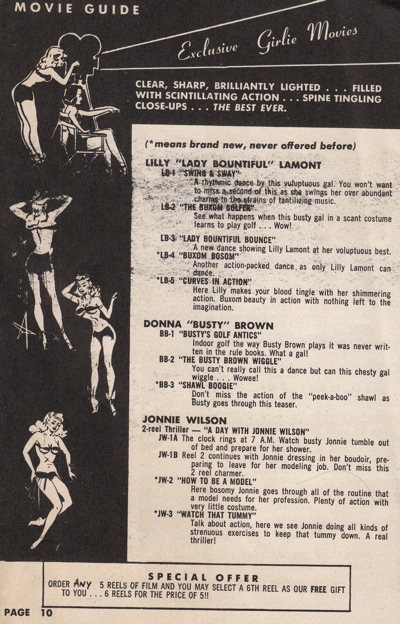
Jim Winkel, author, insatiable collector of ephemera and ringleader behind an incredible circus of blogs — including the treasure trove dull tool dim bulb — is helping me solve a mystery.
I purchased a striptease album featuring this saucy minx from a San Telmo antiques vendor, and now I’m dying to know everything about her. She’s labeled as “Penny Smith” aka “La Inglesita.” I posed the question to Jim, a connoisseur of old-fashioned smut.
Read his post at Vintage Sleaze to find out more (and to see much, much more of her. [cough *NSFW* ahem.]
Assistant to his father in a silk mill, fashion photographer, friend to Man Ray, X-ray technician, master of solarization and the double exposure…Maurice Tabard had quite the C.V. Unfortunately most of his work was destroyed during the war. Below is a rare oversize filmstrip that has been solarized by Tabard — arresting, no? The Sabatier effect in action.
Film Forum is doing a Bruce Conner retrospective in November, and I am eagerly anticipating seeing the short The White Rose up on the big screen. I’ve only viewed it via Tudou (which also has uploads of Conner’s seminal A Movie and Vivian).
The Beat artist Jay DeFeo spent many years of her life painting just one massive picture. Eleven feet tall, eight feet wide, and weighing almost a ton, it grew so heavy from the built-up layers of pigment that it had to be removed from her studio by cutting away the wall and lifting it out via crane. This process is memorialized by Conner (a close friend) with an almost clinical austerity, augmented by a melancholy Gil Evans soundtrack.
What happened to the painting after the film? It was rarely exhibited due to its size and precarious condition, and was put into storage and plastered over to keep slabs of pigment from breaking off the surface. It was eventually acquired by the Whitney and uncovered many years later. For most viewers, the primary means of encountering Defeo’s legendary painting was through Connor’s film. A protest as well as a lament, The White Rose is a singular testament to Defeo’s life work — a mammoth flower that rarely saw the light of day, but bloomed through the light of the projector.
More: John Perreault’s Artopia essay on “The Rose”
I am often asked which films turned me on to cinema. It’s hard to to determine the exact tipping point, but I think I became a die-hard cinephile, a true stickler-of-the-celluloid when I was taking an afternoon French class at the Alliance Francaise. They were doing a retrospective of Sacha Guitry films all summer and after class I would stick around the quartier waiting for the film to begin, perhaps going to Fauchon (which — dégueulasse! — no longer exists) or Central Park in between. I would then join the thirty-odd senior citizens and show my membership carte for free entry, and was subsequently sucked into his Guitry’s entire oeuvre. (Whether or not you *believe* in auteurism, there is nothing like the experience of finding an director that you truly appreciate to usher you into the art of cinema via his or her unique vision.) Guitry did it for me and I was hooked.
Jacqueline Delubac and Sacha Guitry in Quadrille.
What did I love about these films? I think it was a combination of the joy of being able to follow a good part of the French (for these actors, unlike their New Wave successors, had excellent elocution) and an overall playfulness with words that I regarded as the height of sophistication. I recognized Guitry’s films as mannered and artificial and I loved the stylization of reality — the wit, the unbelievable conceits, the unflappable comic arrogance of Mr. Guitry himself. I adored Jacqueline Delubac and Raimu and Fréhel, eccentric stars that to me could only thrive in French films. There is a scene in Les Perles de la Couronne in which Jacqueline Delubac is forbidden to speak in anything but adverbs because her husband suspects her of flirting with another man. Let’s just say his attempts to limit her communicative powers are in vain, and there isn’t a soul who has used a single part of speech more suggestively, ever. (Good grammar is sexy, folks. Well, at least to me.)
Heureusement, the new box set from Criterion includes four of the best Guitry films (though I do wish I could swap out Quadrille for Mon Père Avait Raison) and it is a glorious introduction to his substantial and overlooked contribution to cinema. The beginning of Le Roman d’un Tricheur is a tongue-in-cheek, behind-the-curtain peek at the stagecraft of cinema, and a good taste of Guitry’s irreverent, let’s-poke-fun-at-haute-culture approach. (Also, if you notice, Kind Hearts and Coronets is as indebted to Le Roman d’un Tricheur as Bladerunner is to Metropolis.) For better or for worse, these are the films that initiated my love affair with cinema.
Gatsby guys and gals were out in full swing last weekend for the Jazz Age Lawn Party on Governor’s Island. I ab-so-lute-ly adore this soirée for two reasons: Not only is it a fabulous excuse to don a vintage ensemble, but because people take such care in getting all the little details right — from phonographs to antique cars to turn-of-the-century wooden stools from the World’s Fair. When the music starts up and the hooch starts flowing, you really do feel like you’re on a movie set or that you just might have traveled back in time.
First things first: outfit time! For my ensemble, I looked to the silent screen goddesses for inspiration, turning to Ms. Lillian Gish & Mary Pickford and a host of other nameless lovelies (Do a Google Image search for Vogue and 1920’s. DO IT NOW. By the way, when did Image search become so much more heart palpitatingly awesome?). My favorites, below:
Norma Shearer (top row center), Mary Pickford (middle row left) and Lillian Gish (bottom row left), three of my favorite silent stars.
Because I am obsessed with authentic vintage (not vintage-inspired, but The Real McCoy) I went to April’s edition of the Manhattan Vintage Clothing Show — a dangerous and wonderful extravaganza in which I am reduced to sobbing child who can’t have everything. After searching endlessly for a frock in good condition, I found a floaty 1920’s garden party number, along with some matching toe-tappers.
Vintage dress and shoes from Another Man’s Treasure. (This boutique is based in NJ, and the owners are wonderful people.) The bag looks like a tortoiseshell and the gloves are courtesy of Jennifer’s grandmother.
And now the party: In addition to the fantastic music, I had the pleasure of meeting some true clothing connoisseurs. Watch and learn, vintage fashionistas: Heidi is perhaps the best-dressed woman in the city, period. (pun intended.)
There was also a Bathing Beauties & Beaus Promenade, which took some guts to enter. But a girl’s gotta do what a girl’s gotta do (and truthfully this did not take much arm-twisting).
The Bathing Beauties and Beaus, en masse. And, oh hey, here’s a video of the whole shebang!
For participating in the promenade, I received a copy of Zelda, the magazine dedicated to vintage nouveau. Among other delightful treasures and tutorials — how to pin-curl your hair! — it features interviews with Robert Osborne of TCM and the last surviving Ziegfeld girl, Doris Eaton Travis. An interview with 1930’s starlet Marsha Hunt (who was quite the dish) really gets at why I go to such great lengths to recreate the past, and why we look to old movies for inspiration to create a better life:
I generally and genuinely thing the old was better, was more becoming…I’d carry it beyond clothing and into music and manners: how we treat each other…and so, if you have a love of given period, follow it. You can invent your own styles of living that are consistent with what was worn then.
Well said, Ms. Hunt. If this speaks to you and you think the past was better than the present, then it’s up to you to recreate it. This is partly why I think true cinephiles cherish old movies so much, which teach us a few things, among them how to dress, how to dance, how to act and how to live.
P.S. Start brushing up on your Charleston — there’s another Jazz Age Lawn Party in August! I’m already planning my outfit, which might involve sequins. Stay tuned.
THE CYNEPHILE needs to build up its street cred, ergo a post about street art! (and with the term, ergo, I destroy any possibility of having any ‘cred’ whatsoever…sigh). Anyway I am deliberately using the term street art instead of graffiti, because I do think the two practices differ in important ways. Banksy’s latest film, Exit Through The Gift Shop, does a good job at elucidating the differences between bombing subways and tagging to a more illustration-based & three-dimensional approach, starting with Space Invader (pew! pew! pew! pew!).
Aside from Banksy’s annoying burka-cum-voice-distortion routine, this film is actually very funny, and an excellent primer on the evolution of street art. The title, as you have already deduced because you are infinitely smarter than me, is a comment on street art’s institutionalization and commercialization. What happens when you take an art form predicated on the defiance of authority and stick it in a museum? You get rules and “don’t touch” signs and mugs emblazoned with Andre the Giant — lame.
But if you want to travel back to street art’s roots (aka graffiti) you HAVE to watch Style Wars, the definitive doc on the subject.This film was way ahead of its time (it was shown on PBS) and is mostly good when it doesn’t revert back to a slightly problematic voice-of-god narration mode. (*cough *cough “To some it’s art. To most people however, it is a PLAGUE that NEVER ENDS.” ahem).
The best part? Some kindred spirit has uploaded the entire film onto YouTube!
When I was in Buenos Aires, I saw some really amazing large-scale street art. Is taking pictures of graffiti touristy? Do I somehow betray my native New Yawk by praising another city’s street art? If so, I am a geeky tourist and a shameless traitor.
And then there’s Blu, the graffiti artist whose animations have been making the rounds on the web. I would give my eyes, ears, nose and throat to see Blu in action. (ok maybe not all of those). Blu is an Italian graffiti artist that paints narratives that unfold over time. He creates something, takes a picture, changes it a little bit and then takes another photo. All of these photos put together at warp speed become a film — but instead of happening on an old-fashioned animation cell it happens on public surfaces. (Take that, Walt Disney.)
The reason posting has been virtually nonexistent is very exciting: I’ve started a new job at BAM, which is everything I dreamed it would be. Aside from a hot mess of a commute, I love being part of such an eclectic and forward-thinking organization. BAM’s programming is avant-garde in an extreme way, and I can’t wait for the upcoming Next Wave Festival, which features boundary-pushing work from gasp-out-loud artists, such as Laurie Anderson, Pina Bausch, Mikel Rouse, and more. Of particular interest for the cinephile set are two theatrical interpretations of art cinema classics: Throne of Blood and The Marriage of Maria Braun. It will be interesting to see if these conform to the Broadway trend of adapting movie concepts faithfully for the stage (Hairspray, Grey Gardens) or if they’ll depart wildly in their own direction.
My new home away from home.
But someone recently gave what is perhaps the best and most obvious piece of advice about this blog to date: don’t be afraid to show a little personality. While I think bits and pieces of Cynthia have occasionally peaked out from behind the curtain, I’ve played this blog pretty straight and narrow, sticking to topics that I’ve found fascinating but leaving out any personal details that flesh out my engagement with them. I’ve also avoided some not-so-serious subjects (such as my year-long search for a vintage bathing cap that resembles the one Lea Massari wears in L’avventura which I WILL WEAR TO THE BEACH ONE DAY) lest doing so would destroy my already questionable intellectual credibility.
But it’s the summer, and it’s so hot that I’m serioously contemplating pulling a Marilyn and sticking my undies in the fridge, and more importantly, THE CYNEPHILE is six months old and I’m starting to feel comfortable with the whole online persona thing (comfortable enough for Twitter, even.) In other words, the gloves are off. Expect way more posts that will reveal unhealthy amounts of time spent on YouTube, Ebay and thrift-store sagas of my obsessions with all things French and from the Forties (all in a vain pursuit to become Arletty, from Le Jour se Lève) and maybe even some original video. Stay tuned.