THE CYNEPHILE

"The cinema is cruel like a miracle." -Frank O'Hara

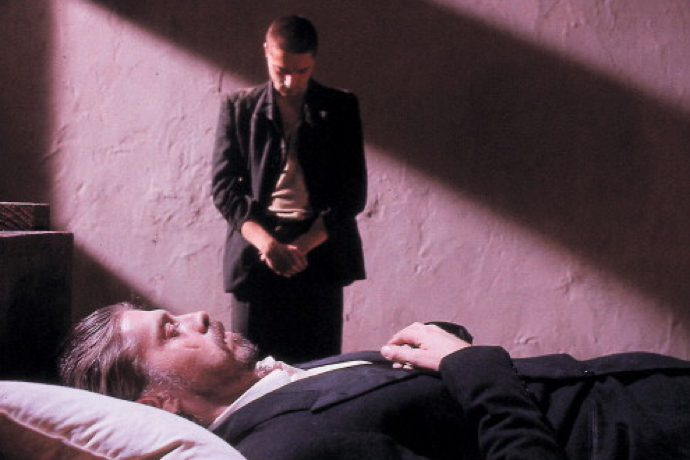
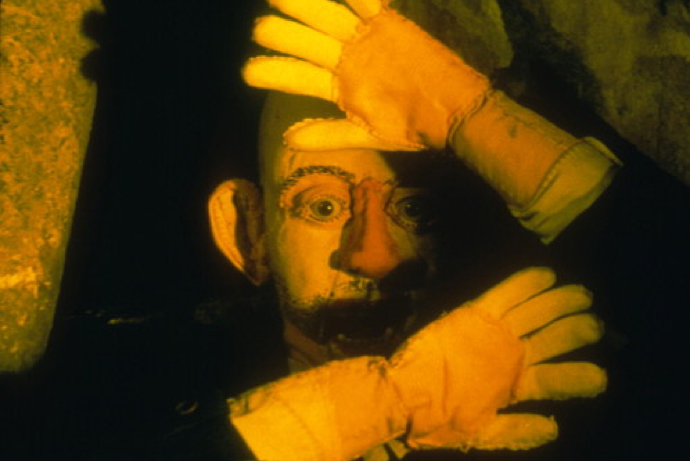
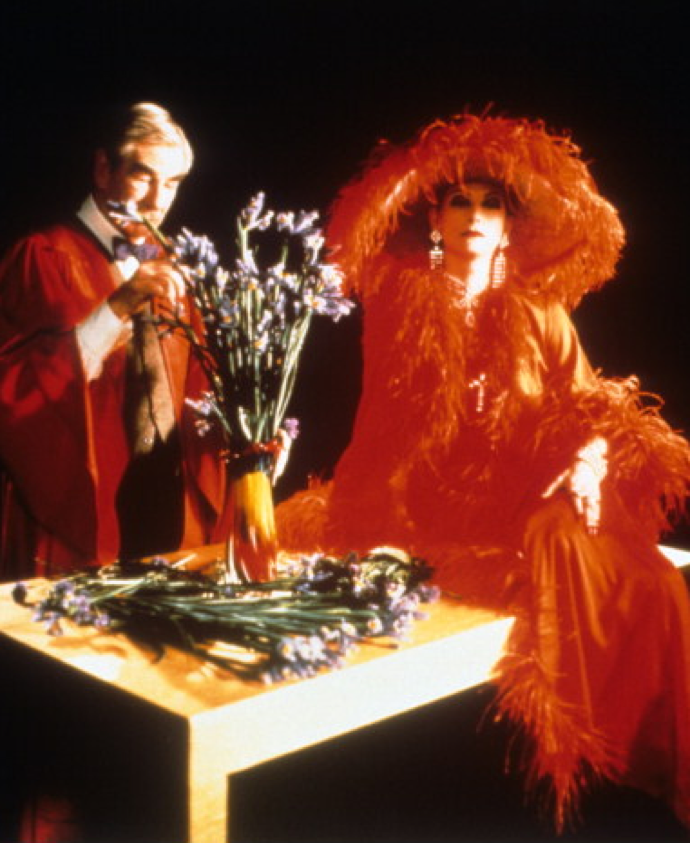
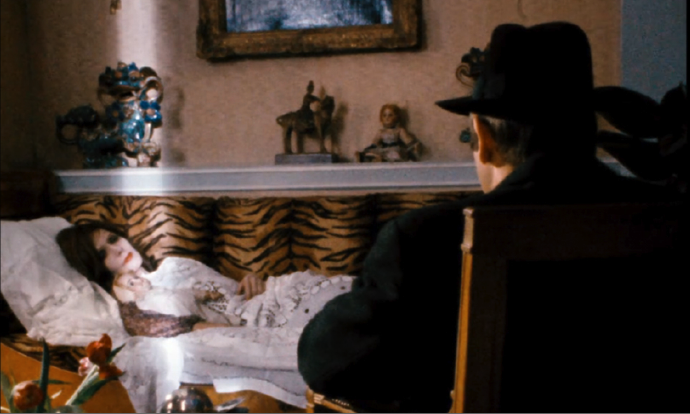
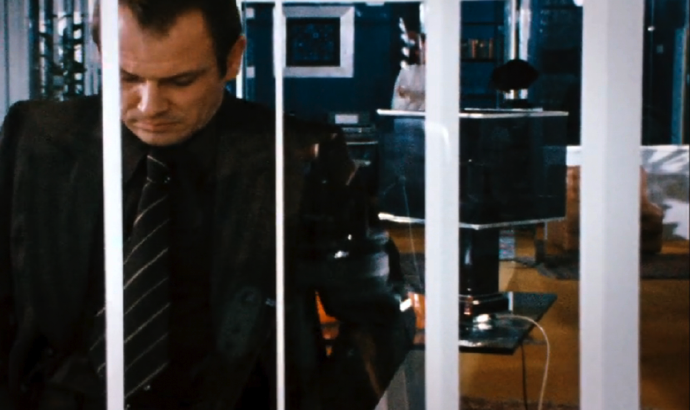
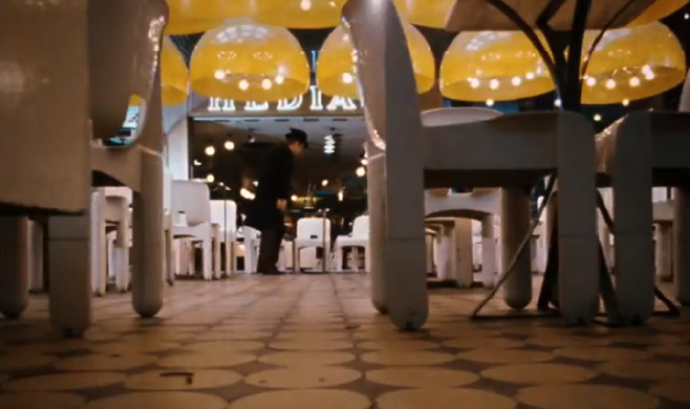
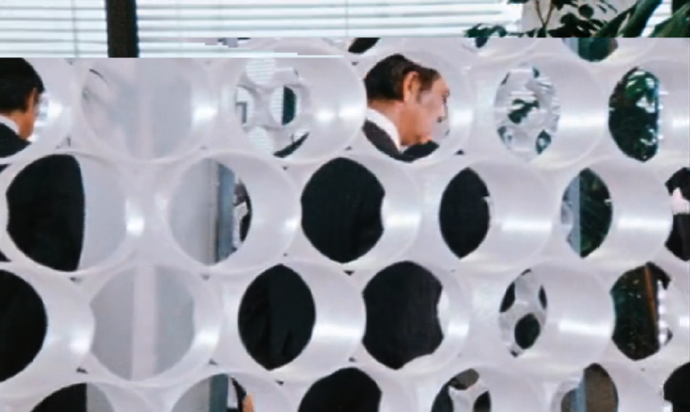
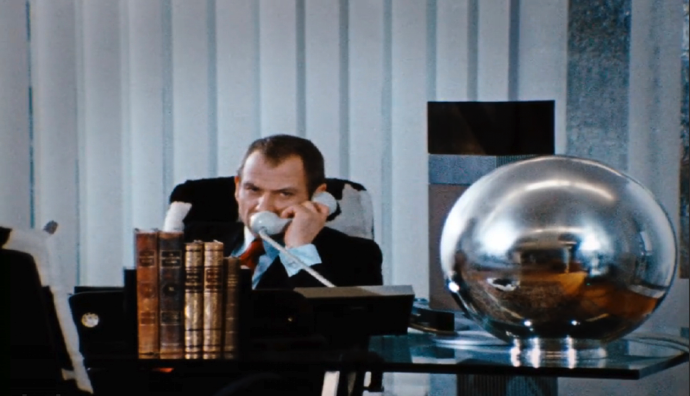
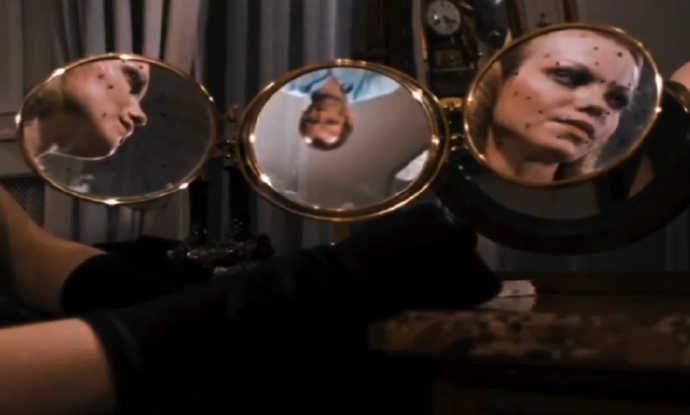
World on a Wire [Fassbinder, 1973]

I actually grew up almost alone without parents.

I really grew up like a little flower.

I’ve been seeing films since I was five, first, covered-wagon Westerns, and then, from the age of seven, I saw everything. I actually went to the movies every day, and later, two or three times a day, if possible.

Band of Angels, White Heat…the relationship between James Cagney and his mother, is I think like that between all my heroes and their mothers. Then Huston’s Asphalt Jungle was very important, and Howard Hawks, the gay stories…

What Sternberg does with light. The ability to tell stories in a roundabout way. It’s this extreme artificiality which is still, in my opinion, something very much alive.

Any film that is narrated conventionally all the way through would turn out like Chabrol and without the crime plot and simply using alienation technique, it might have turned out like a Godard film.

I don’t know, to me all stories are crime stories. To me the everyday oppression people experience is criminal. I could almost go as far as to say that you can’t really make anything but crime films. Everything should be declared criminal.

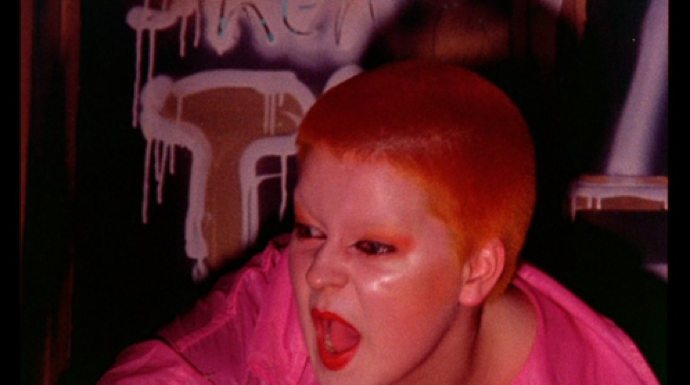
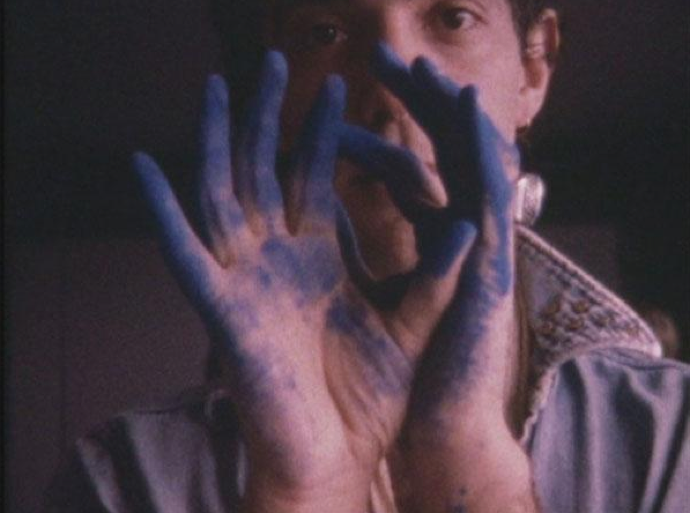
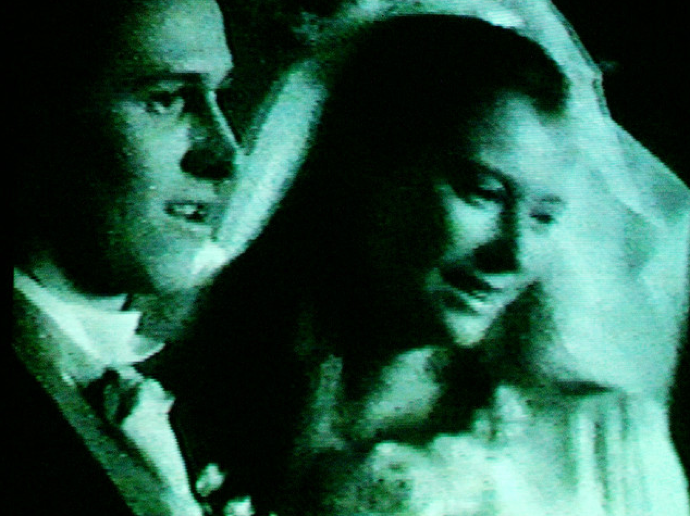
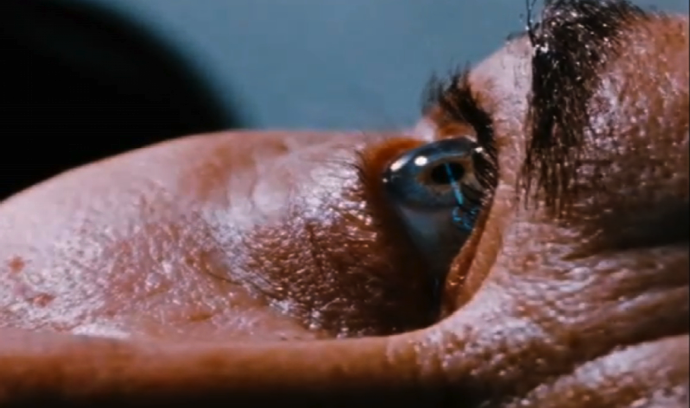
[Film stills from World on a Wire, opening this Friday at the IFC Center. Quotations from The Anarchy of the Imagination: Interviews, Essays, and Notes by Rainer Werner Fassbinder.]

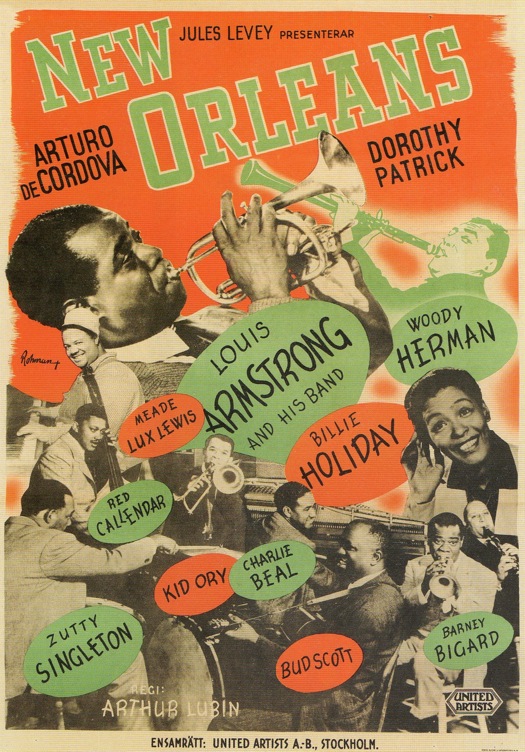
New Orleans [Arthur Lubin, 1947]

This movie, while short on decent story and plot, is a real treat for jazz fans.

new orleans eric rohman poster

The Swedish poster (designed by Eric Rohman) is a snappy photo-collage of all the great jazz musicians of the day. While they are all supreme jazz ambassadors representing the Big Easy, it doesn’t get much better than Billie Holiday backed by Louis Armstrong in this smooth number:

Marilyn Monroe: Actress, Icon, ______

Marilyn Monroe was known for two things above all: a dazzling smile and a tremor in her voice. On the screen, those features were shaped into a surprisingly varied cast of characters. The Marilyn who knocked everybody out cold in Some Like it Hot is different from the Marilyn who almost stole Monkey Business right out from under Ginger Rogers’ nose. And the show-stopping Marilyn who proved, once and for all, that Gentlemen Prefer Blondes is yet another Marilyn, a four-alarm fire practically burning a hole through the screen in Niagara.

She had considerable dramatic range as an actress, and a well-honed sense of comedic timing. As Montgomery Clift’s character Perce Howland mulls in The Misfits, “She’s kinda hard to figure out, you know? One minute she looks kinda dumb and brand-new, like a kid… and the next minute…” Her character, as well as the actress herself, remains an enigma, to be showcased in BAMcinématek’s series, Marilyn!, from July 1 to 17.

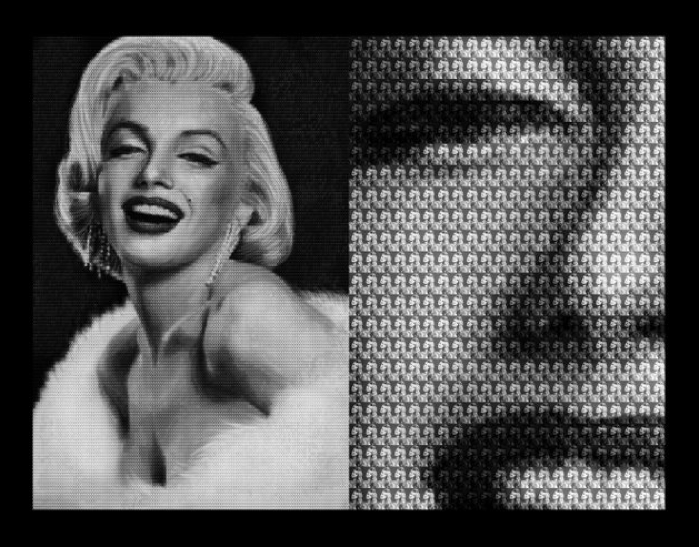
But first, let us consider Marilyn’s mythic projection, or Monroe the icon. This Marilyn is indelibly written into our consciousness as the golden, open-faced beauty, epitomizing a healthy American sexuality and a vulnerable, childlike innocence. Here, all the nuance of her myriad characterizations is lost, and she becomes a series of frozen images. This is the Marilyn from The Seven Year Itch who felt the gust of air from the subway grate, immortalized with her dress blooming around her like a flower. This is Andy Warhol’s silkscreened Marilyn, her celebrity reduced to her mug in a rainbow of colors reproduced ad infinitum. This is Marilyn in the realm of high camp, draped in diamonds and surrounded by ostrich plumes, cooing “Diamonds Are a Girl’s Best Friend.” There are abundant variations on this theme but the girl at the center remains the same: an erotic fantasy, an imaginary creature that can only exist in the cinema.

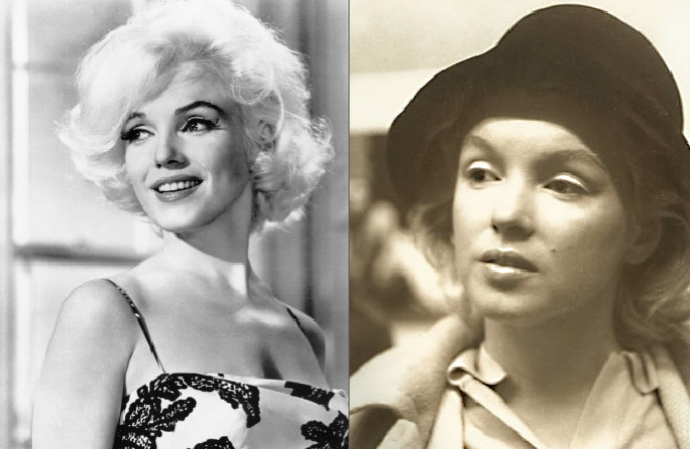
"Marilyn Vs Brigitte Bardot" by Alex Guofeng Cao

Monroe’s beginnings were far from auspicious. The woman who was to become a universally known and loved icon of the 20th century was born Norma Jeane Mortenson in Hollywood. Her mother was a film cutter at RKO Studios who, widowed and mentally ill, abandoned her to a sequence of foster homes. Monroe’s childhood was marked by crippling poverty and abuse, and she married at 16. It was then that she started to achieve some success as a model and was scouted by Howard Hughes, then the head of RKO Studios. He offered her a screen test but she ended up signing with 20th Century Fox. Her first major break as an actor was in John Huston’s gritty LA film noir, The Asphalt Jungle, in which she played a memorable mistress that lit up each of her scenes. She won another small but significant role in Joseph Mankiewicz’s All About Eve, in which she held her own among a formidable cast that included Bette Davis and Anne Baxter. Mankiewicz predicted her rise to fame, claiming that she had that certain indescribable something, that ineffable star quality. Watching All About Eve, it is evident that Marilyn knew she had it too.

But she wanted to play more than arm candy. In addition to roles for which Monroe is celebrated, the BAMcinématek series includes some underrated gems that never achieved box-office success but nevertheless remain crucial landmarks in her development as an actress. The first of these is Don’t Bother to Knock, her first serious role in which she plays a mentally unhinged babysitter. She’s unstable and creepy, and it’s thrilling to watch her face morph from hardened to sweet to insecure in an instant. Still another role in which she expands her repertoire is opposite Robert Mitchum in the thrilling action epic River of No Return, shot in lush CinemaScope. But if you see just one film from this series, let it be John Huston’s twilight Western, The Misfits, penned especially for her by her then-husband, playwright Arthur Miller. Film critic Pauline Kael wrote of Marilyn dismissively, proclaiming “When she was ‘sensitive’ she was drab,” but Monroe has never been more sensitive than in The Misfits, and has never looked more radiant. Miller wrote this role particularly with Monroe’s dramatic strengths and biography in mind, and it’s astounding to watch. It’s also the last film that she completed.

Shy, bright, sensitive, and unaffected, Monroe hated being a star. She was the woman most fantasized about by men (a fact that embarrassed her), yet fame became a painful thorn. It’s an old story, but still a sad one, and whatever factors contributed to her untimely death, one thing is certain: Marilyn was made for the medium of film.

Some belated documents surrounding an Illegal screening of Film Socialisme

A friend just pointed me to this fascinating exchange of emails published in the December issue of Harper’s surrounding an underground screening of Film Socialisme that never took place. Here’s the gist of it: the collective Red Channels organized the screening; the Film Society found out and they (along with Wild Bunch, the film’s distributor) threatened to sue if they went through with it. Not surprisingly, the screening was canceled. I remember being invited to the screening on facebook, so I included that text too, because I think it’s pretty telling.

Here’s a PDF of the email exchange here (quick read, I promise).

And here is the original invite promoting the “ non-screening”

Godard’s Final Struggle: Socialism(e) from Below
We are not hosting, organizing, or sponsoring a screening of Jean-Luc Godard’s Film Socialisme. Our event is not the World, North American, United States, festival, or theatrical premiere of Film Socialisme. Our event is in no way a violation of agreements between the Film Society of Lincoln Center and Wild Bunch, Wild Bunch and Vega Film, Vega Film and Jean-Luc Godard. Our event is not in opposition to the Film Society of Lincoln Center’s premiere of Film Socialisme. We wish no one any alarm. Our event is a group reflection and response to the future and legacy of Jean-Luc Godard, filmmaker, in anticipation of his newest feature film, Film Socialisme, screening officially at the New York Film Festival. We welcome discussion on the future of socialism, internationally, with filmmakers and socialists, artists and revolutionaries. It’s a party. Please join us at this private social night.

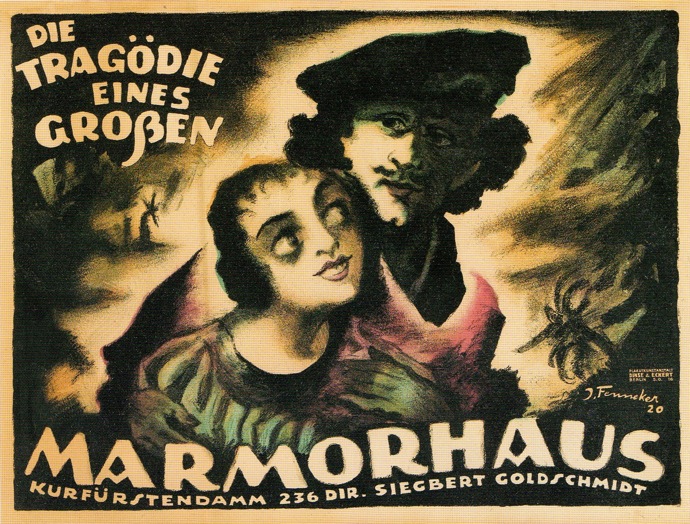
Josef Fenneker, The Tragedy of a Great Man

Within a decade after he settled in Berlin, in 1918, Josef Fenneker designed more than 300 movie posters. He primarily worked for two movie houses, the Mamorhaus and the Mozartsaal, but he also designed images for the large German movie producer UFA. From the beginning of his career, Fenneker developed his own personal style, which drew largely on German Expressionism combined with a flair for decadence.

He primarily depicted elongated and distorted figures emerging from dark backgrounds, and punctuated them with unusual, hand-drawn typography. This poster is for the silent film The Tragedy of a Great Man, the story of Rembrandt van Rijn. The atmospheric image, with its murky background offset by the wide, adoring eyes of Saskia (Rembrandt’s wife) is a fascinating confluence of Old Master and German Expressionism.

Raymond Depardon, The Picture Thief

I would give anything to be in Paris right now to catch Raymond Depardon’s La France at the BNF, in order to see his miraculous and ordinary (yes, those two words can go together) photographs up close. Raymond Depardon is a photographer and a filmmaker, the French equivalent to a modern-day Paul Strand, and film work has often been compared to Frederick Wiseman. Depardon’s overarching sensibility is that of reverence for small and intimate improvised experience. The result is that each ordinary moment he photographs is enshrined and somehow emblematic of both a dense sweet past, and a thinned out, scattershot present.

Jean-Michel Frodon’s review of the exhibition in Slate.fr is a beautiful piece of writing in its own right. Here is a translated passage that encapsulates the essence of Depardon’s style:

“There is no secret in these photos, no revelation. Depardon’s art was never that of the knockdown, it was often noted for his documentaries about the quality of listening. With his enormous camera, he listened to everyday landscapes. And everyone hears. Everybody hears something, but never the same thing. Everyone takes ownership of these images, they live in our own memories, as reflections as done over time, and most often kept to oneself.”

Depardon’s New York, NY is a film that epitomizes the act of listening. A mobile portrait of the 59th Street Bridge — shot most likely from the Roosevelt Island tram — the film is both intimate and spare. There are some iconic shots of Wall Street, and then we traverse the bridge again with our eyes, this time at night:

Depardon describes his process as that of a flâneur losing himself in the crowd. This passage is from his essay entitled “The Picture Thief”:

I would seek cover amidst the throngs of people in the busy streets of these big metropolises. For a few hours, a few days, I was an inhabitant, a special kind of local. I remained a foreigner, but I was adopted and protected by the crowd. I have always liked being invisible, disappearing as soon as I’m noticed and slipping unobserved from one street to the next without trying to hide. I remained a tourist a little off the beaten track, full of curiosity, but always an amateur.

I think Depardon is overdue for a New York retrospective, similar to the one MoMA mounted for Wiseman. His filmography is vast and varied, and includes documentary, narrative, and short-form work. Unfortunately, not much is available on DVD.

More:
An interview with Depardon in Cinemascope [Engilsh]

The Cynephile’s Top Ten Movies of 2010

So here’s my offering of films that knocked me out this year — not a complete list, nor something that follows any sort of rigid selection rules. I’ve omitted repertory screenings so that the list is roughly contemporary (though some may have been theatrically released in Europe in 2009). But we will not split hairs here, shall we? Years come and go, but great movies are hard to find. Onward!

1. DOGTOOTH. An authoritarian father virtually isolates his children from the rest of the world and puts a chokehold on the media. Sound like any totalitarian regimes today? Through this surreal and sickly comic film, Yorgos Lanthimoss produces possibly one of the greatest, most fucked-up allegories about control versus freedom ever.

2. EXIT THROUGH THE GIFT SHOP. If this street art “documentary” is a Banksy prank, it’s a pretty damn good one. Plus, I am still humming this. Carry on Mr. Brainwash, whoever you may be.

3. VINCERE. An epic and wholly original masterpiece from one of Italy’s most underappreciated filmmakers. Bellocchio presents a winning take on Mussolini (the man turned icon) through uncovering the family we never knew he had. Giovanna Mezzogiorno doesn’t hurt either.

4. I AM LOVE. Could Tilda Swinton be any more captivating in this movie? Could the mise-en-scène be any more gorgeous? Could the score be any more majestic? And where can I order some of those prawns? Though I wrestled with some of its over-the-top moments, sequences from this film stayed with me for days, as did the music. I gave in.

5. ALAMAR. An exquisite, almost wordless portrait of the bond between a father and son while they cling to methods of the old world. Truly unique and unlike any film I’ve seen before in its approach to many nuanced subjects, this film “speaks” in gestures and is the closest thing to a child’s handprint in clay.

6. RUHR. James Benning makes an avant-garde film about trains, and it feels like the fulfillment of the apocalypse. Only he could make something that feels so simultaneously gritty and mystical.

7. THE GHOST WRITER. An taut thriller that needed nothing more than old-fashioned political intrigue and a more-than-competent cast to summon up some excellent suspense. I wish more mainstream films were as good as this one.

8. LAST TRAIN HOME. This documentary is about more than the annual Chinese New Year migration; it’s about a daughter breaking away from her parents. Both experiences feel harrowing and very real in this film.

9. PLEASE GIVE. This very New York, very funny movie reminded me of early Woody Allen.
The humor is wry, but the film has its touching moments too, not to mention a super ensemble cast. I wish more “quirky mainstream” or “mainstream indie” (mindie?) films were like this.

10. BLUEBEARD. It’s fascinating to see Breillat explore the twinned axes of the fairy tales and childhood to explore the formation of the gender roles and processes of sexualization that have always fascinated her. (That’s my girl’s school education showing, sorry.) She also wins for best final film shot of the year.

Runners-up: Film Socialisme, White Material, A Prophet, The Father of My Children, Mother,
Around a Small Mountain, 12th and Delaware, Henri-Georges Clouzot’s Inferno, Erie, The Silent Holy Stones.
Notably Absent: The Social Network, Inception

On Terrible Movies with Julia Roberts

So: she’s everywhere, with her big teeth, and I can’t stand it. Eat Pray Love has reared its ugly promotional head. For a non-eating (ok, maybe that part’s not true) atheist-leaning cynic such as myself, I cringe every time I see a poster, a promotion, or goddess forbid, the trailer. Aside from making me question the accomplishments of feminism on a daily basis, I also can’t fathom what exactly is supposed to be entertaining about the plot:

People: THIS IS A MOVIE ABOUT A WOMAN WHO GOES ON VACATION. Go on vacation yourself. Or plan a staycation and eat some Neapolitan pizza. Do not go see this move.

Those who know me probably can picture my face at this moment. But for those who can’t, here you go:

Don’t I look ready for a “vacation” at the insane asylum? Doctor, If I wrap myself in a celluloid, will it go away?

My reaction to the trailer was similar to my response to the advertising campaigns for It’s Complicated and The Ugly Truth,
which — even though I never set foot into a movie theater to see these puppies — made me physically recoil upon looking at them. The posters in particular made me feel so sad for Meryl Streep and wish the oh-so-boring Katherine Heigl would stick to the middling Grey’s Anatomy and JUST STOP doing bad chick flicks that made me avoid fuschia at all costs. Manohla felt my pain too.

I generally have little to no tolerance for these demographically-determined commercial movies, and choose not to see them. (And to those who will criticize me because I obviously haven’t subjected myself to the torture of actually watching the film: you don’t need no weatherman.) But I wondered what the point of detesting them so virulently was, until I came across this quote from the inimitable Andrew O’Hagan:

“Maybe I’m too young in the head and haven’t spent enough time in Los Angeles or psychoanalysis, but I think it’s quite important sometimes to hate things, not to be amused by them, or loftily tolerant of them, but to want to cut off their oxygen supply and mash them into the ground, thereafter to plant something lovely in their place. Maybe a bad novel is just quieter, a bad gallery hanging almost private, while terrible movies starring Russell Crowe seem to come bounding towards you from every space in culture, leaving you no choice but to reach quickly for the elephant gun and fire…” (From his essay “Two Years in the Dark”)

That’s it exactly — bad movies are simply inescapable in our current media environment. You can’t not know about The Proposal or Julie & Julia or [fill in any movie with an aggressive advertising campaign here] even if you avoid all television, as I do. I’ve come to the crotchety conclusion that I find this noise offensive. But this also poses a significant challenge for good films without publicity machines behind them: how do they break through the awful and incessant blathering that these films make? That was once the critic’s role — to convince audiences that taking a risk on art could reap rewards far beyond Oprah-isms applied like a salve to society’s wounds. But can anyone really escape the jaws of Eat Pray Love, and America’s sweetheart’s teeth? Maybe the answer is to fight fire with fire, and mash it up into oblivion. Here’s a parody starring a Tibetan monk for the road. Let’s hope there’s more where that came from.

3D: A Study in Depth

Film Forum is in the midst of a Classic 3D film series that is eye-bulgingly essential for anyone who cares about the past and future of cinema. I dragged a friend to see KIss Me Kate on Sunday and we were transported to such a state of euphoria (spinning diamonds! saucy lyrics! silly outfits! jazz hands! gangsters spouting Shakespeare!) that leaving the theater was like coming out from under ether. (Admittedly this experience was augmented by some ‘50s-era wax soda bottles from Economy Candy that gave us both a suitable sugar high.) According to the trailer, Kiss Me Kate was the greatest event in the history of our times:

Kate is that great, and those who delight in the golden era of 3D will be knocked out by Film Forum’s pristine dual projection. Moreover, cinephiles who are sickened by the success of the behemoth Avatard and the bumper crop of unnecessary 3D titles that it has spawned will get a much better sense of the untapped potential of “depthies,” then and now.

First things first: all filmmaking is three-dimensional in the sense that motion pictures provide many depth cues that we also use on a daily basis to perceive the visual world. However, stereoscopic cinema maintains the illusion of extending into the space of the audience, going boldly where no movie had gone before.

One could make the argument that three-dimensional cinema is inherently more realistic, because it locates objects in space, rather than on a flat, two-dimensional plane. And it certainly expands the visual field, bringing the spectator seemingly closer to the image. However, it is more accurate to say that three-dimensional is hyper-realistic, or radically exhibitionist, because instead of the spectator’s vision directed “inward” towards the screen, the image is literally directed “outward” towards the spectator. The 3D film, in essence, does the work of perception for the spectator—it commands us to focus on this character or that part of the mise-en-scène, simply by the jutting out of certain pictorial elements over others.

3D cinema, therefore does the finger-pointing for us — look at this here, right now! A 3D model of spetatorship is inherently anti-Bazinian because it rejects any notion of the interior life of the screen image — and infantilizes the spectator who prefers to let his eye roam over the image. I think this explains why die-hard cinephiles dismiss these films as passing novelties, films in which objects were hurled at the spectator and film art was nary a concern — the cinematic equivalent to a paintball game. However, a surprising number of prestigious and high-budget features were shot using 3-D (but not necessarily released that way). The list is impressive: it includes Kiss Me Kate, along with House of Wax, The Charge at Feather River, Miss Sadie Thompson, Creature from a Black Lagoon, and Dial M for Murder.

Dial M for Murder is a example of how three dimensional processes can be used to create effects that transcend mere gimmicks; Hitchcock shows admirable restraint and allows for the action of the film to dictate 3-D movement along the Z-axis. The film is based on a stage-play, and most of the action takes place in the living room of a London apartment. (As a director, Hitchcock had a definite techno-fetish, exploring rear-screen projection, matte, and other unconventional techniques. 3D was no exception, though Hitchcock was a late adopter, coming around to the process in 1954.) In Dial M for Murder, composition and movement are carefully controlled: the first half of the film is static and consists only of subtle maneuvering between lamps, chair arms, and other household items jutting out in front of the actors. Every shot was masterfully executed with proper camera movement and very precise convergence.

Dial M for Murder contains three outstanding examples of 3-D virtuosity. First are the tight, extreme close-ups on wristwatches; second, the suspenseful shot of a telephone dial as the murderer pokes his finger into the number six hole, the titular “M.” Both shots were faked using a giant prop technique, making it possible to manage extreme close-ups without inflicting eyestrain, and demonstrating Hitchcock’s ingeniousness for outwitting the limitations of 3D.

Hitchcock’s most obvious and effective three-dimensional moment comes during the murder itself: As the murderer attempts to strangle poor gorgeous Grace Kelly, she is forced back across her desk, and her grasping hand is thrust out at the audience as she reaches for scissors to stab the murderer. Even here Hitchcock demonstrates restraint, as the movement of the stabbing goes away from the camera rather than toward the camera and audience. I saw a 3D projection of Dial M for Murder a number of years ago and I’ve never forgotten this scene. It’s playing Aug 21 and 22 at Film Forum — don’t miss this!

Being Bit By Charlie [Chaplin]

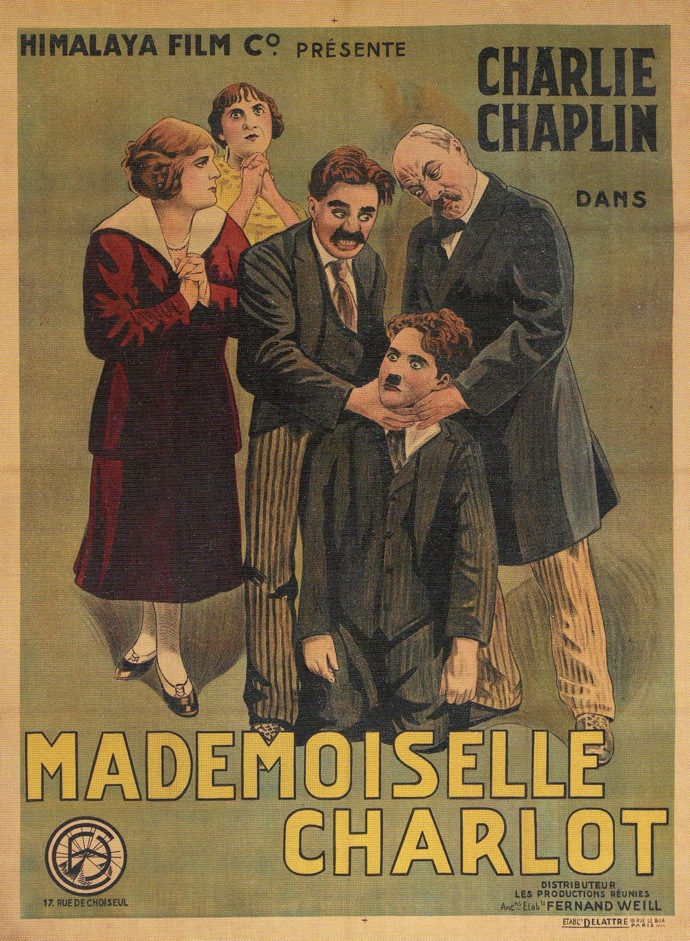
So I’m coming off the high that was Film Forum’s Charlie Chaplin Festival and I can’t stop thinking about what makes Chaplin so singular as a performance artist for me. Perhaps there are no words — fitting for a mostly silent star. As I learned over the course of the series, Chaplin also shone brightly in speaking parts, but his true genius is centered mostly in his body as a threshold for human movement — especially as movement gathers force in his seismographic face. I could wax on for hours about that exquisite piece of tissue — framed by those twitchy brows and set off with an iconic exclamation point of a mustache — and its mimetic power. When Chaplin smiles, the audience cannot help but smile with him. In James Agee’s essay on Monsieur Verdoux he expresses regret that his words can only approximate Chaplin’s greatness: “I can only hope that these notes may faintly suggest the frame-by-frame appreciation; the gratitude; and the tribute which we owe this great poet and his great poem.” In that spirit, here are a few of my favorite Chaplin moments, film by film.

MODERN TIMES: Chaplin must perform a song to a packed house. He forgets the words and makes up something that sounds vaguely Italian, complete with saucy gestures. Side-splittingly funny.

THE CIRCUS: A slew of monkeys make a late entrance and predictably steal the show.

CITY LIGHTS: The tramp and his rich tippler of a friend sit down to eat. Spaghetti, confetti, what’s the difference?

THE GREAT DICTATOR: Chaplin as Der Phooey is full of hot air.

THE IDLE CLASS: This short contains one of my favorite Chaplin moments of all time. Watch it all the way through — there’s a big payoff that involves a cocktail shaker!